
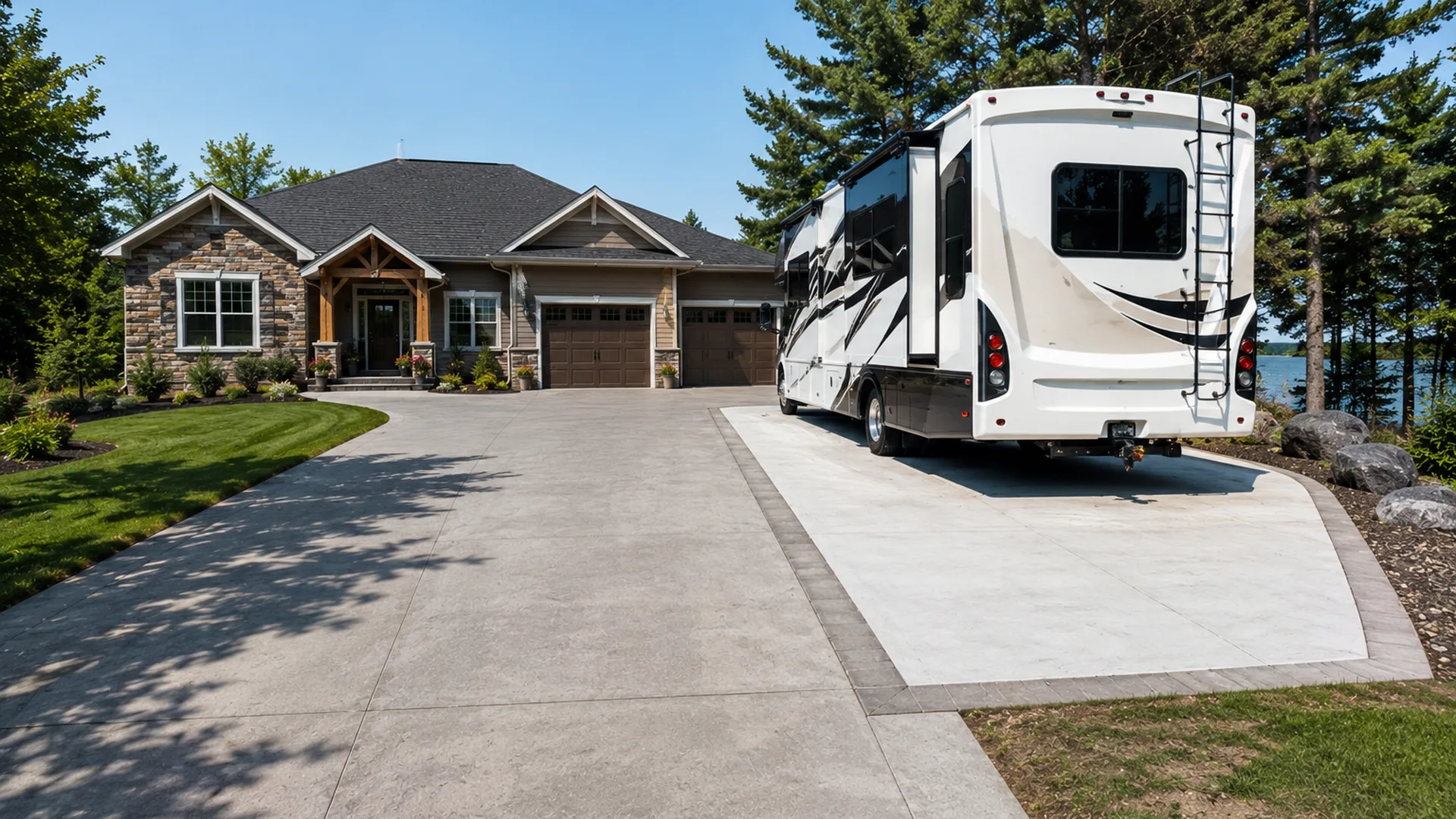
RV/Boat Driveway Pad Installation Conroe TX: Built for Montgomery County Clay & Rain
Conroe TX Driveway Experts handles rv/boat driveway pad installation for Conroe homeowners and property owners across Montgomery County. We assess what's there now, plan the work around your property's specific conditions, and build or rebuild it to the same structural standard as new construction. RV and boat trailer pads carry loads a standard driveway is not built for, which is why we build them to the heavy-duty standard: 6 inch concrete depth with #4 rebar on 12 inch centers, rather than the 4 inch, #3 rebar spec used for a passenger-vehicle driveway. This is especially common across the acreage properties around Willis, Splendora, and the rural belts of eastern Montgomery County, where RVs, boats, and horse trailers are a daily reality, not an occasional guest.
Call (936) 284-3720Get a Free Driveway Quote
No obligation. We will call or text back, usually same day.
RV/Boat Driveway Pad Installation Conroe TX
Here is what a rv/boat driveway pad installation project with Conroe TX Driveway Experts actually looks like on the ground, from the numbers that matter to the details most quotes skip past.
A standard driveway spec under an RV pad will crack and settle within a year or two under the repeated point-loading of jack stands and axle weight. We do not downgrade the heavy-duty spec to save cost on these pads.
At a glance: 6 in. is the heavy-duty slab depth, #4 Rebar covers 12 inch centers, doubled from standard spec, and 3-4 Days is the figure for typical pad installation timeline. Budget-wise, most homeowners land in the $8.50 to $13.50 per sq. ft. installed range, with a typical project running $5,100 to $8,100 for a typical 600 sq. ft. pad; 6 inch depth with #4 rebar on 12 inch centers.
- 6 inch concrete depth, up from the 4 inch standard driveway spec
- #4 rebar (1/2 inch) on 12 inch centers, a denser and thicker grid
- Sized to your specific RV, boat, or trailer dimensions and turning access
- Sub-grade compaction to the same 95 percent standard, critical under heavier loads
Cutting Corners
Build an RV pad to standard driveway thickness to save on concrete cost
Our Approach
Build to the full 6 inch, #4 rebar heavy-duty spec every time
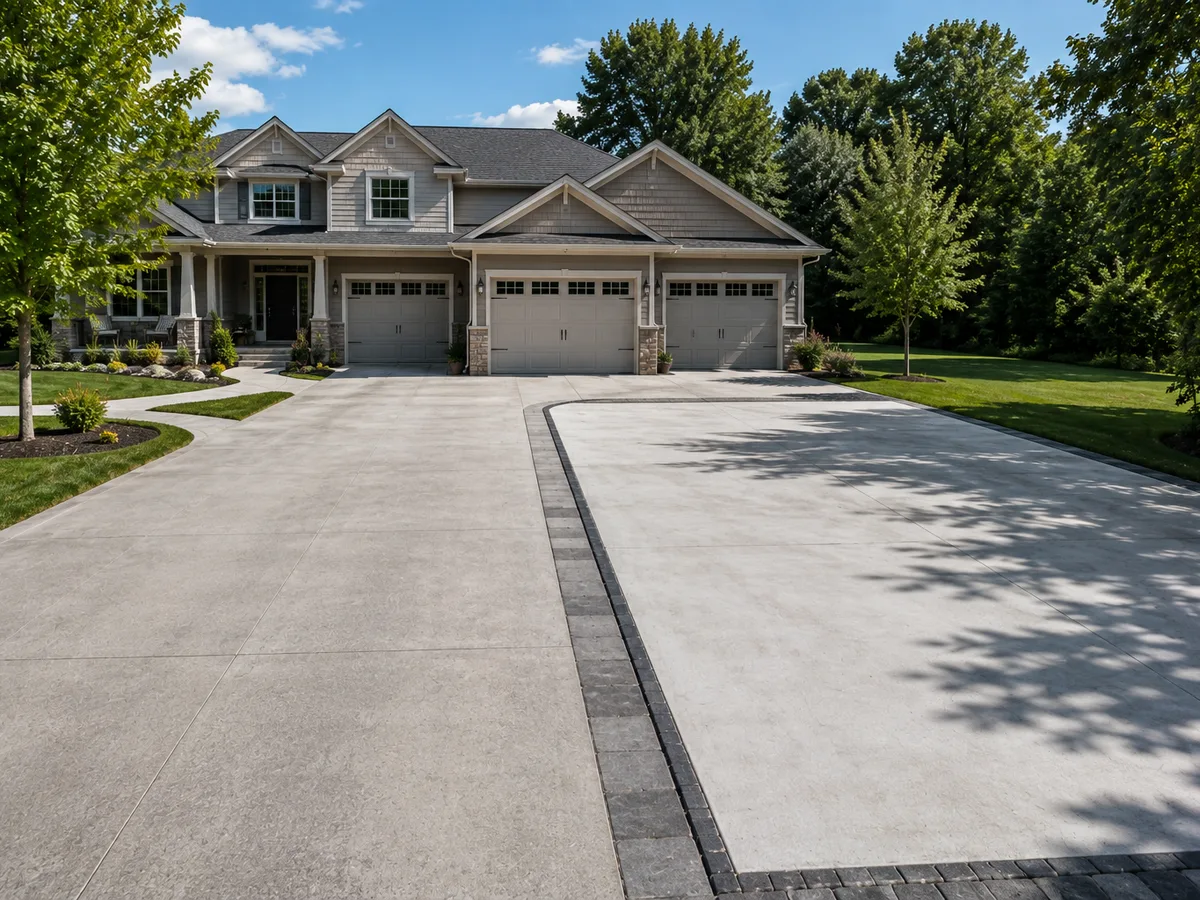
Technical Specs
- Slab depth
- 6 inches, versus 4 inch standard driveway
- Rebar grade
- ASTM A615 Grade 60, #4 (1/2 inch)
- Rebar spacing
- 12 inch centers, denser than standard
- Sub-grade
- 95 percent Standard Proctor Density, non-negotiable under heavy loads
Quick recap: Slab depth is 6 inches, versus 4 inch standard driveway | Rebar grade is ASTM A615 Grade 60, #4 (1/2 inch) | Rebar spacing is 12 inch centers, denser than standard | Sub-grade is 95 percent Standard Proctor Density, non-negotiable under heavy loads.
RV/Boat Driveway Pad Installation: What Actually Matters
An RV, boat trailer, or livestock trailer puts a fundamentally different kind of load on concrete than a passenger vehicle does. Jack stands and tongue weight concentrate enormous point loads on a small slab area, and a standard 4 inch driveway spec, built for evenly distributed passenger car weight, will crack and settle under that kind of concentrated loading within a year or two. That is why our RV and boat pads are built to a genuinely different spec, not a scaled-down version of a driveway.
We pour to 6 inches of depth with #4 rebar, twice the diameter of standard #3 rebar, set on 12 inch centers rather than the wider 12 to 18 inch spacing used on a passenger driveway. This denser, thicker structural grid is what actually carries concentrated point loads without cracking, and it is a direct match to the heavy-duty spec used for commercial and municipal applications that see similar loading patterns.
Sub-grade compaction matters even more under a heavy-duty pad than under a standard driveway, since any settlement under a concentrated jack stand load shows up as a much more pronounced dip than the same settlement would under evenly distributed car weight. We hold every RV and boat pad to the same 95 percent Standard Proctor Density standard, with lime stabilization on high-PI clay sub-grades, because cutting a corner here under a heavy pad fails faster and more visibly than it would under a standard driveway.
Before We Arrive
A little prep on your end keeps the rv/boat driveway pad installation timeline on track. Here is what actually helps, specific to this job, not a generic moving-day checklist.
- Provide the dimensions and approximate weight of your RV, boat, or trailer before the design visit
- Clear the pad area and access path for equipment and heavier concrete delivery trucks
- Note where you plan to position jack stands or tongue supports, since load points matter
- Plan for a longer cure period before placing heavy point loads on the new pad
- Confirm access clearance for maneuvering your specific vehicle onto the finished pad
How Your RV/Boat Driveway Pad Installation Works
Four stages, start to finish. We will tell you which day you are on and what to expect next, rather than leaving you guessing mid-project.
Dimension & Load Planning
We measure your specific vehicle and plan pad size and load points around it.
Heavy-Duty Sub-Grade Prep
The sub-grade is tested and compacted to 95 percent density, with lime stabilization if needed.
Structural Pour
6 inch concrete is poured over #4 rebar on 12 inch centers, the full heavy-duty spec.
Cure & Access Walkthrough
We confirm cure time and walk vehicle access and positioning with you.
Long-Term Care for Your RV/Boat Driveway Pad Installation
A rv/boat driveway pad installation is not a set-it-and-forget-it purchase. What keeps it performing years down the line comes down to two things we build in from day one: sized to your specific RV, boat, or trailer dimensions and turning access, and sub-grade compaction to the same 95 percent standard, critical under heavier loads. Both matter more over time than they do on day one, which is exactly why we do not skip them to shave a day off the schedule.
Beyond the build itself, a standard driveway spec under an RV pad will crack and settle within a year or two under the repeated point-loading of jack stands and axle weight. We do not downgrade the heavy-duty spec to save cost on these pads.
Typical Cost Range
6 inch depth with #4 rebar on 12 inch centers. Every quote reflects your specific site, sub-grade condition, and material choice, not a generic flat rate. We would rather walk your property and give you an accurate number than quote blind over the phone and adjust it later.
RV/Boat Driveway Pad Installation FAQs
Real questions we hear from Montgomery County homeowners before booking rv/boat driveway pad installation, answered plainly and without the sales pitch.
Can I just park my RV on a standard driveway?
You can, but a standard 4 inch driveway spec is not built for the concentrated point loads from jack stands and axle weight, and will typically crack and settle under an RV or large trailer within a year or two.
How much thicker is an RV pad than a regular driveway?
6 inches versus the standard 4 inches, paired with denser #4 rebar on 12 inch centers instead of the wider standard grid, roughly matching commercial-grade concrete specs.
Do I need a permit for an RV pad on my property?
It depends on whether the pad connects to a public road or sits entirely within your existing driveway footprint. We can flag this during the site visit.
Do I need to be present while you build my RV pad?
We recommend being present for the initial dimension and load-point planning visit, since it is specific to your vehicle and how you use it.
Do you offer free quotes for RV and boat pad installation?
Yes, including a load assessment based on your specific vehicle's weight and dimensions.
Is rv/boat driveway pad installation the right fit for every property in the Conroe area?
Not automatically. What stays consistent on every job is the standard we build to: 6 inch concrete depth, up from the 4 inch standard driveway spec, and #4 rebar (1/2 inch) on 12 inch centers, a denser and thicker grid. The specific approach still gets adjusted on-site to your lot's actual soil and drainage, which is why every quote starts with a real site visit rather than a phone-only estimate.
How long should a rv/boat driveway pad installation last before it needs major work again?
It depends heavily on whether the sub-grade and base were built correctly the first time, which is the single biggest factor in longevity across every material we install. A rv/boat driveway pad installation built to spec, with proper compaction and the right material choice for your soil, should give you many years of service before anything beyond routine maintenance is needed.
What voids a warranty or shortens the life of a rv/boat driveway pad installation?
The two most common culprits we see are skipped sub-grade prep on the install side and neglected drainage on the maintenance side. Water finding its way under or beside a driveway, and clay sub-grade that was never properly compacted or stabilized, account for the overwhelming majority of early failures we get called out to diagnose.
Ready for RV/Boat Driveway Pad Installation in the Conroe Area?
Call Conroe TX Driveway Experts for a free, honest quote built around your specific soil, drainage, and budget.
Call (936) 284-3720